No products in the cart.

The Woman Who Dared to Bet on Herself
There is a moment that comes before every woman who ever built something.
It is not the moment she launched. Not the moment she got her first client or registered the business or told someone out loud what she was doing. It comes earlier than all of that. Quieter. More private.
It is the moment she thought — really thought, for the first time without immediately dismissing it — what if I actually did this.
And then the next moment, almost indistinguishable from the first, when every reasonable, responsible, well-meaning voice in her head told her exactly why she shouldn’t.
Most women never get past that second moment. Not because they lack the talent. Not because the idea wasn’t good enough. But because the distance between thinking and doing requires something no business course teaches and no mentor can give you.
It requires betting on yourself. Fully, uncomfortably, with no guarantee of return.
And women, in particular, have been taught to find that bet reckless.
She was not afraid of failing. She was afraid of being seen wanting something and not getting it. And once she understood that distinction, she stopped letting it stop her.
What we were taught about risk
Safety first. Build on solid ground. Don’t leave until you have something to go to. Make sure before you move. Wait until you’re ready.
Good advice for crossing a road. Slow death for a woman with something to build.
The problem is not the advice itself — some version of it is practical and true. The problem is the specific heaviness with which it lands on women. The way financial risk gets coded as irresponsible for us in a way it doesn’t for men. The way ambition gets quietly pathologized. The way the woman who wants to build something of her own is asked, gently but persistently, whether she’s really thought this through.
As if the years she spent thinking it through while doing someone else’s work for someone else’s dream didn’t count as thinking.
As if wanting something badly enough to risk something for it is a character flaw rather than the entire engine of every business that has ever existed.
The specific fear that stops women
It is not failure. Not exactly.
Women are not afraid of working hard or getting it wrong or starting over. They have been doing all three of those things for years inside jobs and relationships and lives that were never quite built for them.
What stops them is something more specific and more personal.
It is the fear of being seen wanting something and not getting it.
The fear of having declared — to their partners, their families, their colleagues, to themselves — that they believed in something enough to bet on it, and then being wrong in public. Of the quiet devastation of the people who said be careful watching them fail. Of having to return to the life they left with the evidence of their own overreach visible to everyone.
This fear is not vanity. It is the accumulated weight of being a woman in a world that has always been slightly more interested in women failing than succeeding. That has always had a particular appetite for the story of the ambitious woman who didn’t make it.
She has absorbed that appetite. And it lives in her now as caution. As reasonableness. As one more year in the job that is slowly, quietly extinguishing her.
What entrepreneurship actually asks of a woman
Not perfection. Not certainty. Not a flawless business plan or a full financial runway or the blessing of everyone who loves her.
It asks her to tolerate ambiguity. To act before she is ready because ready is a myth she will be chasing until she runs out of time. To make decisions with incomplete information, which is the only kind of information available to anyone building anything real.
It asks her to become comfortable with being misunderstood. Because the woman building something new is always slightly ahead of the explanation for what she is doing. And people who cannot see where she is going will fill that gap with skepticism, with concern, with the particular kind of unsolicited advice that is really just their own fear in a helpful costume.
It asks her to develop a relationship with herself strong enough to survive the months when nothing is working. When the clients are not coming and the money is tighter than she planned for and the voice that said be careful is louder than it has ever been and she cannot call it wrong yet because she is still in the middle of proving it so.
This is the part that breaks the women who were building for the wrong reasons. And reveals everything about the women who were building for the right ones.
What she finds when she begins
She finds out who she actually is.
Not the version of herself that existed inside a structure someone else built. Not the employee, the team player, the person who was good at executing someone else’s vision with reliable competence. The real one. The one with opinions about how things should be done and the particular stubborn clarity of a woman who has finally stopped managing herself down to fit someone else’s ceiling.
She finds out she is more capable than she knew. Not in the motivational poster sense — in the practical, specific sense of realizing she can do things she had no evidence she could do. She can sell. She can handle rejection. She can figure out what she doesn’t know. She can make something from nothing on a Tuesday when everything feels impossible and there is no one above her to solve it.
She finds out what she actually values. Because entrepreneurship strips everything back to the essential question — what is this for? — with a regularity that employed life never demands. And answering that question honestly, again and again, builds a clarity about herself and what she is building that changes her permanently.
The part nobody glamorizes
It is lonely in a way she didn’t anticipate.
Not always. Not terminally. But there is a specific loneliness in being the only person who fully understands what she is building and why. In carrying the weight of the vision when no one else can see it yet. In the gap between where she is and where she is going, which is a gap she crosses largely alone.
There are months when the income is terrifying. Months when she questions every decision she made to get here and several she hasn’t made yet. Months when she watches her former colleagues get promoted and feels, against her better judgment, a version of envy that sits uncomfortably alongside her conviction.
She does not always feel like the woman in the success story. Sometimes she feels like the woman in the cautionary tale. The difference between the two is almost entirely a matter of whether she quits.
She does not quit. Not because she is fearless but because she has come too far into herself to go back to the version of her life that was safe and airless and slow.
What betting on yourself actually means
It does not mean certainty. It does not mean knowing it will work.
It means deciding — clearly, privately, with full knowledge of the risk — that the cost of not trying is higher than the cost of failing. That the woman who tried and failed is someone she can live with. That the woman who never tried because she was waiting to be ready is not.
It means treating her own instincts as credible. Her own vision as worth protecting. Her own time as the most valuable resource she has — more valuable than the false security of a salary, more valuable than the approval of people who will not be there when the thing she builds finally becomes undeniable.
It means, at the most fundamental level, deciding that she is worth the bet.
Not because the outcome is guaranteed. Because she is.
What is waiting on the other side
Not ease. Not the version of success that looks like arrival.
A life she built. Entirely, imperfectly, stubbornly hers. Work that carries her name and her vision and her specific, irreplaceable way of seeing the world. The particular satisfaction of a woman who stopped waiting for someone to give her permission and gave it to herself.
And something quieter than all of that. Something she will not have words for until she is inside it.
The knowledge that she showed up for herself when it mattered most. That when the moment came — the private moment, before the launch and the clients and the story she will one day tell — she heard the voice that said what if I actually did this and she chose it.
Over safety. Over certainty. Over the slow comfortable suffocation of a life lived below her own potential.
She chose it. And it changed everything.
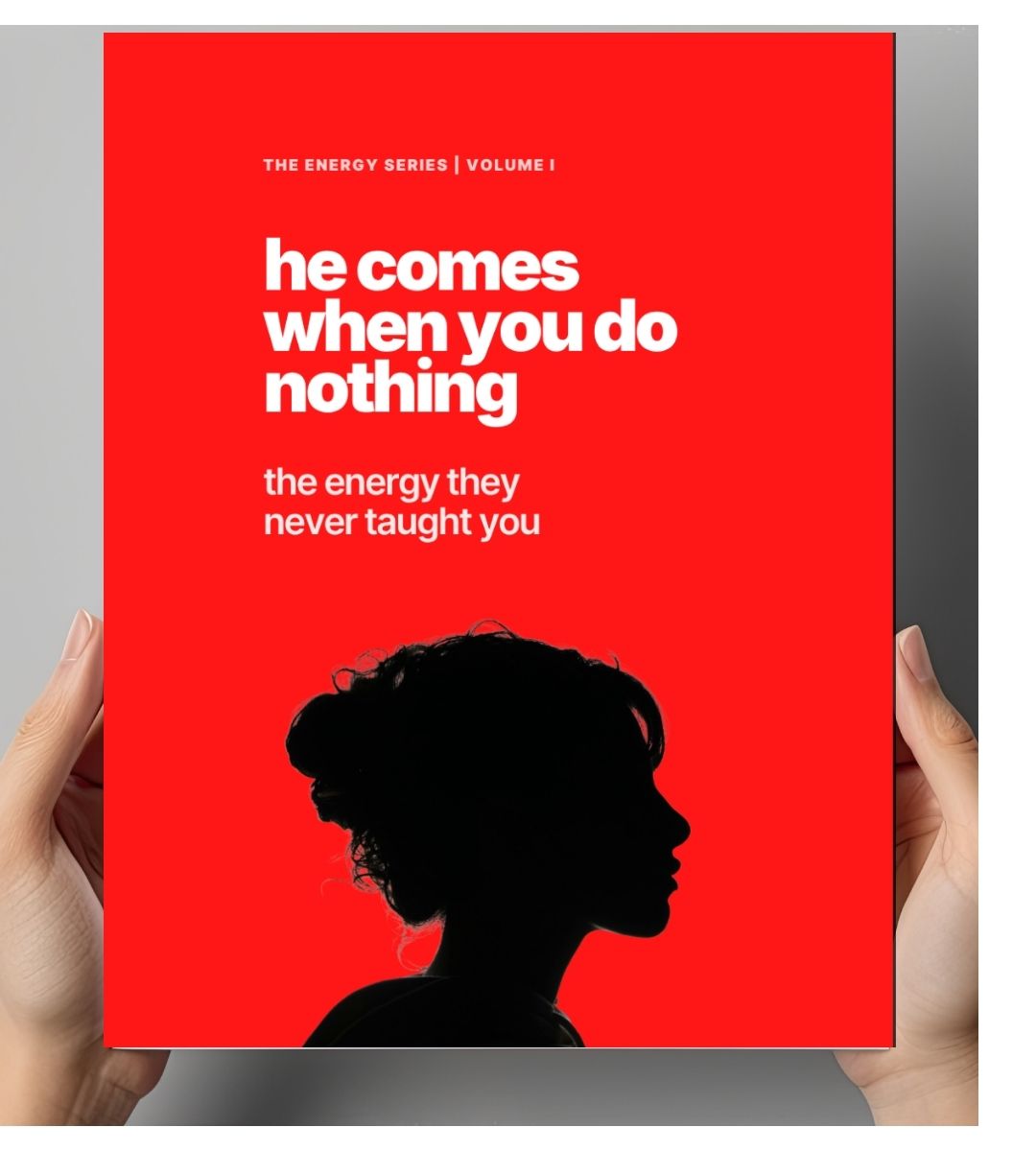
He comes when you do nothing
This is a method—not motivation. It is built to rewire your presence, not just inspire your mind.
The energy they never taught you. Thousands of women have already shifted. They never chased again. They became the most desired women in the room. Now it’s your turn.
“The most powerful shifts are often the simplest ones.”
Instant Download · Secure Checkout · Private Access
He comes when you do nothing
This is a method—not motivation. It is built to rewire your presence, not just inspire your mind.
The energy they never taught you. Thousands of women have already shifted. They never chased again. They became the most desired women in the room. Now it’s your turn.
“The most powerful shifts are often the simplest ones.”