No products in the cart.
The Japanese Folktale That Explains Every Relationship You’ve Ever Been In
There is a Japanese folktale that most people have never heard of. And yet, the moment you encounter it, something in you goes completely still.
Because you recognize it. Not as a story. As a memory.
It goes like this.
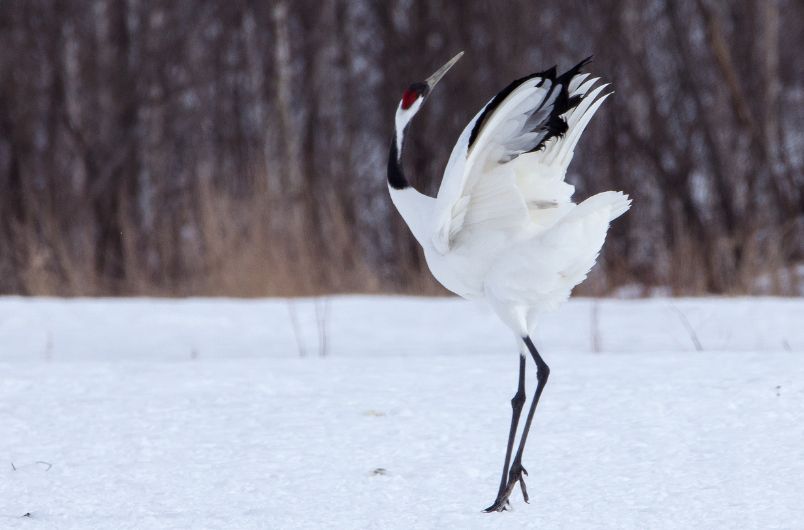
A crane falls in love with a man. She knows — she understands, with the particular clarity of a creature who has been watching the world from above — that he will not love her as she is. A bird is too wild, too strange, too other. So she does what women have been doing in one form or another for centuries. She plucks out her feathers. One by one. Night after night. Until she looks enough like a woman to be loved.
And he loves her. Of course he loves her. She made herself loveable.
But the feathers don’t grow back the same way. And she grows quieter. And smaller. And one day there is nothing left to pluck and she is gone — not because he left, but because she disappeared herself, slowly and voluntarily, in the name of a love she was never quite sure she deserved as she was.
You have read this story before. You lived it. Most women have.
She made herself into a woman before he had the chance to choose the bird. She removed the question by removing herself. And so she will never know if the crane was always enough.
The feathers we pluck
They are never dramatic, the first ones.
That is the thing no one warns you about. The self-erasure doesn’t begin with a grand sacrifice. It begins with something so small you barely notice it. An opinion swallowed because the argument doesn’t feel worth it tonight. A preference abandoned because his matters more right now. A plan cancelled because his need felt more urgent than yours.
Each one, reasonable. Each one, a choice you made freely. Each one, a feather.
The problem is that feathers have a way of not growing back exactly as they were. And the more you remove, the more natural the removing feels. Until one day you are sitting across from someone who loves you — genuinely, in his way, loves you — and you realize that the person he loves is a version of you that you constructed entirely for his benefit. Softer than you are. More agreeable than you are. Less inconvenient, less complicated, less real than you are.
He loves the woman without feathers. He has never met the crane.
Why she does it
Not because she is weak. The crane is not a weak creature.
She does it because she understands, somewhere beneath the logic of it, that to be loved is to be legible. That wild things are admired from a distance but not brought home. That the full truth of what she is — complicated, untamed, with an interior life that cannot be fully mapped — is too much for the love she is being offered.
And she wants the love. That is the part that gets left out of the moral of the story. She genuinely wants it. The wanting is not shameful and it is not a weakness. It is human.
But she makes a calculation, conscious or not, that the love on offer is worth more than the self required to receive it. And she begins the slow, steady work of becoming someone who fits inside the life that has been extended to her.
This is not stupidity. It is a particular kind of hunger. The hunger to belong to someone. To be chosen. To have proof, finally, that you are the kind of woman someone stays for.
And so she plucks. And plucks. And plucks.
The man in the story
He is not a villain. That is important.
He did not ask her to remove her feathers. He did not demand she make herself palatable. He simply loved what was in front of him and did not look too closely at what it cost her to be there.
This is the most honest and the most devastating part of the folktale. The harm in it is not malice. It is the harm of being loved for something you performed rather than something you are. Of having someone hold your hand without ever knowing your name.
He believed she was a woman because she became one for him. And in doing so, she robbed them both — him of the truth, and herself of the possibility of being loved for it.
This is the thing about love built on a version. It cannot hold the real thing when it finally surfaces. And the real thing always surfaces.
The version we tell ourselves
Every woman who has ever plucked her feathers has a story she tells herself about why it is not plucking.
It is compromise. It is growth. It is choosing what matters. It is learning to be less reactive, less demanding, more understanding. It is becoming the woman I want to be anyway. It is what love requires.
And some of that is true. Love does require something. Relationships do ask us to grow and shift and make room for another person.
But there is a difference between growth and disappearance. Between softening and dissolving. Between choosing to expand and being slowly, quietly reduced.
The woman who is growing still recognizes herself at the end of it. She is larger, more complex, more capable than she was before.
The woman who is disappearing looks up one day and cannot find herself anywhere in the life she has built.
The crane knows which one is happening. She has always known. She simply keeps plucking because stopping feels more dangerous than continuing.
The moment it ends
It always ends the same way in every version of the story. Not with a fight. Not with a revelation. Not with him finally seeing what she gave up.
It ends with her running out of feathers.
There comes a point where there is nothing left to offer. Where the self has been so thoroughly excavated in service of the relationship that the woman who shows up is hollow. Tired in a way that sleep doesn’t fix. Going through the motions of a love she can no longer feel because feeling requires an interior life and she gave hers away piece by piece.
And he notices something is different. Something is wrong. She is not the woman she was — warm, accommodating, endlessly available. She is quiet now. Distant. She has gone somewhere he cannot reach.
He is right. She has gone somewhere. She has gone back to herself. What remains of herself.
And from that place — scraped bare, finally honest — she has to decide. Whether to begin again. Whether to return to who she was before the first feather fell. Whether the love that remains is the kind that can survive her wholeness.
Most of the time, it cannot. Because the love was built for someone she was pretending to be. And it has no architecture for the real thing.
What the folktale is actually about
Not self-sacrifice. Not even love, exactly.
It is about the oldest question a woman carries. Whether she is enough as she is. Whether the crane — wild, strange, fully herself — is a thing worth loving. Or whether love requires the performance of something more palatable, more human, more contained.
The tragedy of the story is not that she lost him. It is that she will never know. She made herself into a woman before he had the chance to choose the bird. She removed the question by removing herself. And so she will never have the answer she was plucking toward all along.
The answer, of course, is yes. The crane was always enough. She always was.
But that is the knowledge that comes after the feathers are gone. After the relationship ends. After the long, quiet work of growing them back — different this time, slower, more carefully guarded.
She learns it too late for that love. But not too late for the next one.
And the next time, she enters the room fully feathered. She lets herself be seen as she is — wide-winged, a little wild, entirely herself.
And she waits to find out if this one can love a crane.
The only question worth asking
Before the next relationship. Before the next compromise. Before the first feather falls.
Ask yourself — not whether he is worth it. Not whether you are asking for too much. Not whether you are being difficult or irrational or too much of any of the things you have been told you are too much of.
Ask whether the love being offered to you has enough room for the crane.
If it does, stay. Open your wings. Let yourself be fully, outrageously, unapologetically seen.
If it doesn’t, no amount of plucking will save it. You will only lose yourself in the trying. And you will need every feather for the life that is still waiting for you.
Save them.