No products in the cart.
The Women Who Dress for Themselves Are the Most Threatening Women in the Room
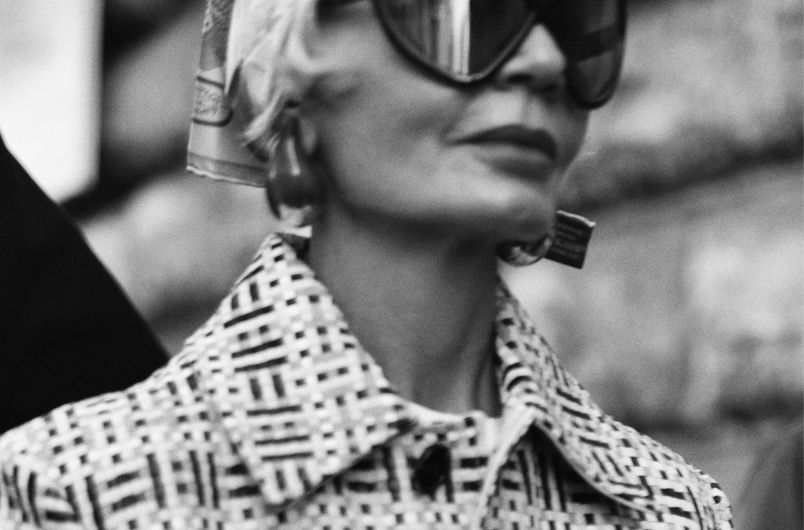
There is a woman you have encountered. Maybe at a dinner, maybe walking past you on the street, maybe in a meeting where she was supposed to be just another person at the table.
She was dressed in a way that made no particular effort to please anyone. Not provocatively. Not aggressively. Just — completely, quietly, on her own terms. And something about it made the room uncomfortable in a way nobody could name.
That discomfort was information.
Real style doesn’t react. It simply exists. It proceeds from the inside outward with no particular interest in what it encounters on the way.
We were taught that dressing is a social act
From the time we are small, women are inducted into the understanding that how we dress is something we do in relation to others. We dress to be appropriate. To be professional. To be attractive. To be taken seriously. To not stand out too much. To not disappear entirely.
Every choice made in reference to an audience.
The question running underneath every outfit is never simply what do I want to wear. It is what will this communicate. What will they think. Is this too much. Is this not enough.
We are so accustomed to this that we have stopped noticing it. The self-editing happens before we even reach the wardrobe. We have already pre-adjusted for a room we haven’t entered yet.
That pre-adjustment is not style. It is compliance.
Style is what happens when you stop asking for permission
Real style — not fashion, not trends, not dressing correctly for the occasion — is the visual expression of a woman who has stopped negotiating her appearance with an imaginary jury.
It is not rebellion for its own sake. It is not the deliberate flouting of expectations, which is still, when you think about it, defined by those expectations. True style doesn’t react. It simply exists. It proceeds from the inside outward with no particular interest in what it encounters on the way.
That is why it is so rare. And why, when you encounter it, something in you responds — with admiration, with envy, with that particular unease that comes from witnessing someone who has access to a freedom you didn’t know was available.
What oversharing actually costs
A woman who dresses for herself is making a quiet but radical claim.
She is saying: my body is not a message I am sending you. My appearance is not a service I am providing. I am not here to be legible, or pleasing, or reassuring, or aspirational. I am here, dressed as myself, and what you make of that is entirely your business.
Most people — men and women both — find this profoundly unsettling.
Because we have a social contract around female appearance that almost no one has explicitly agreed to and almost everyone enforces. Women are supposed to be visually available. Readable. Signalling something — status, approachability, femininity, effort. A woman who opts out of the signalling doesn’t just break the contract. She reveals that the contract existed.
And that is the threatening part. Not the clothes. The awareness behind them.
Why it threatens people
A woman who dresses for herself is making a quiet but radical claim.
She is saying: my body is not a message I am sending you. My appearance is not a service I am providing. I am not here to be legible, or pleasing, or reassuring, or aspirational. I am here, dressed as myself, and what you make of that is entirely your business.
Most people — men and women both — find this profoundly unsettling.
Because we have a social contract around female appearance that almost no one has explicitly agreed to and almost everyone enforces. Women are supposed to be visually available. Readable. Signalling something — status, approachability, femininity, effort. A woman who opts out of the signalling doesn’t just break the contract. She reveals that the contract existed.
And that is the threatening part. Not the clothes. The awareness behind them.
The myth of dressing for confidence
The conversation around women and style has been almost entirely colonised by the language of empowerment. The right outfit gives you confidence. Dress for the job you want. Look good, feel good.
All of which keeps the logic exactly where it was. External. Performative. In service of an outcome.
Real dressing — dressing from identity rather than toward an impression — has nothing to do with confidence in that sense. It is quieter than confidence. It doesn’t need the room to respond in a particular way. It isn’t contingent on anything.
The woman who wears what she loves on a Tuesday with nowhere particular to go, with no one particularly to impress, is doing something more radical than any power suit ever managed. She is treating her own pleasure as sufficient reason.
That is not confidence. That is sovereignty.
What gets lost when we dress for others
Your eye. That’s the first thing.
The sense of what you actually like — separate from what is flattering, appropriate, on trend, acceptable — atrophies without use. Women who have spent years dressing for approval often find, when they try to dress purely for themselves, that they don’t quite know what that means anymore. The personal aesthetic has been so long subordinated to the social one that it has become hard to locate.
This is not vanity. It is identity. And its loss is not trivial.
Because how you dress is one of the few daily acts that is entirely yours. A small, renewable decision about who you are and how you want to move through the world. When that decision is outsourced — to partners, to workplaces, to trends, to the imagined judgment of strangers — something real is surrendered with it.
Not the clothes. The self that chose them.
The women who got it right
They are not who you think. They are rarely the most fashionable women in the room. Fashion, after all, is still an external system — still a set of codes being fluently spoken for an audience that knows how to read them.
The women who got it right are the ones who look, above all else, like themselves. Whose clothes could not have been chosen by anyone else for them. Whose appearance, whether it involves couture or vintage or something completely unclassifiable, has the quality of inevitability. Of course she is wearing that. There is no other version.
That quality cannot be bought and it cannot be copied. It can only be arrived at — through the long, quiet work of deciding who you are and then having the nerve to show up as her.
What this actually requires
Not money. Not a particular body. Not access to anything.
Just the willingness to disappoint the imaginary jury. To wear the thing you love even when you can’t justify it to anyone. To stop editing yourself for rooms before you’ve entered them.
To treat your own eye — your own specific, irreplaceable, idiosyncratic sense of what is beautiful — as something worth listening to.
The women who do this are the most threatening women in any room.
They are also, without exception, the most interesting.